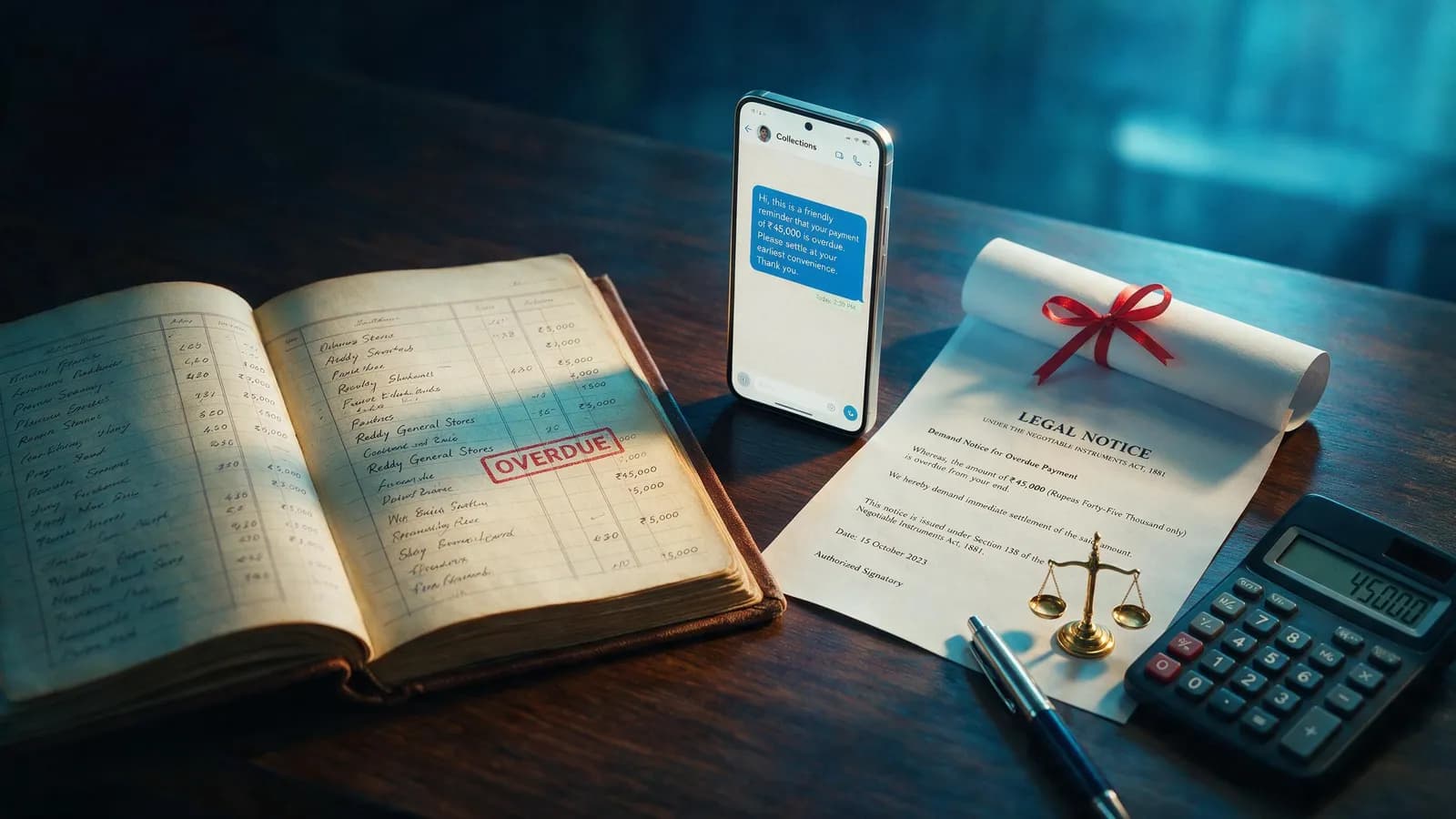
Every trade business in India carries a number it doesn't like to say out loud: the udhaar. Money for goods already delivered, sitting in someone else's pocket — a retailer who says 'agle hafte pakka', a regular customer whose khata crossed ₹4,000 months ago, a client whose invoice is 90 days old. On paper you're profitable. In the bank, you're tight.
Here's the uncomfortable truth most articles skip: udhaar rarely goes bad because the customer is a cheat. It goes bad because the follow-up is embarrassing, irregular, and undocumented. You don't want to spoil the relationship, so you wait. Waiting signals the money isn't urgent. And the customer — juggling ten of their own problems — pays whoever asks clearly and consistently.
This guide is the complete recovery ladder: exact messages to send (copy them), when to escalate, and what your legal options actually are in 2026 — including the one that awards you 16%+ compound interest and costs nothing to file.
First, one rule that changes everything
Never make the ask personal. Make it procedural. 'Bhaiya, kuch paise de do' is a favour. 'Your outstanding is ₹12,450, here's the statement, which date should I note for payment?' is a process. The first invites negotiation and awkwardness; the second invites a date. Every script below follows this rule: specific amount, written record, specific next step.
That also means: before you send anything, know the exact figure per customer — every invoice, every part-payment, current as of today. If your khata is a notebook or your billing is on one shop PC, this is the step where recovery usually dies. (We wrote separately about building a system that prevents outstanding from piling up — this article is about recovering what's already stuck.)
Step 1 — The statement (Day 1): friendly, factual, written
Send the balance on WhatsApp — not a demand, just the fact. WhatsApp matters for three reasons: it's read within minutes, the tick is your delivery proof, and it creates a written trail you may need later. Copy this:
Namaste ji 🙏 Sharing your account statement from [Shop/Firm Name]: Total outstanding ₹12,450 (3 bills, oldest dated 14 June). Statement attached. Please check and tell me a convenient date for payment. UPI: [number]. Thank you!
Namaste ji 🙏 [Firm Name] ka hisaab bhej rahe hain: kul baaki ₹12,450 (3 bill, sabse purana 14 June ka). Statement attached hai. Check karke bata dijiye payment kis din tak ho payegi. UPI: [number]. Dhanyavaad!
Notice what this does: it asks for a date, not money. A date is easy to give — and once given, it's theirs to keep.
Step 2 — The date-keeper (their promised date, or Day 7)
If they gave a date, message on the morning of that date — not after it passes. If they didn't reply at all, follow up on day 7:
Namaste ji, reminder as discussed — payment of ₹12,450 due today. UPI [number] ya cash, jo aasan ho. Receipt turant bhej denge. 🙏
If the date slips, don't lecture. Re-anchor once — 'Koi baat nahi ji. Kal ka pakka rahe? Main kal subah yaad dila dunga.' — then actually message tomorrow morning. Consistency is the whole trick: the customer must learn that your reminders arrive on schedule, every time, without anger. Most people pay simply to make reliable reminders stop.
Step 3 — The freeze (Day 30–45): consequence without conflict
If two promised dates have passed, the relationship needs a boundary, delivered respectfully and in writing:
Namaste ji. Aapka account ₹12,450 par 45 din se pending hai. Naye maal ke liye humein pehle purana hisaab clear karna hoga — company policy hai. Aaj ₹5,000 bhi kar dein to naya order aaj hi nikal denge. 🙏
Three things are happening here: stop new credit (never throw good money after bad), blame the policy, not the person ('company policy' lets both sides save face), and offer a part-payment path — ₹5,000 today genuinely beats ₹12,450 never. For distributors, this is also where a credit limit that automatically blocks the next order earns its keep: the software becomes the bad guy, and your salesman stays the friend.
Step 4 — The formal stage (Day 60+): paper, not phone calls
Past 60 days, verbal follow-up has diminishing returns. Now you escalate on paper — and in India you have real options that most small businesses never use.
| Option | Best for | Cost | Teeth |
|---|---|---|---|
| MSME Samadhaan portal | B2B dues (you supply another business), Udyam-registered sellers | Free, no lawyer | Compound interest at 3× RBI bank rate; council targets 90-day disposal |
| Legal notice via advocate | Any stuck payment worth ₹10,000+ | ₹1,500–₹3,000 | 15-day window; often settles by itself |
| Cheque bounce (Sec 138 NI Act) | When you hold a bounced cheque | Notice + filing | Criminal case — up to 2 years or 2× cheque amount |
| Civil / summary suit, Lok Adalat | Large or bitter disputes | Court fees, time | Decree; Lok Adalat is free and settles in one sitting |
MSME Samadhaan: the lever nobody uses
If you sell goods or services to another business (a distributor supplying retailers, a trader supplying a company) and you have Udyam registration (free, online, 10 minutes), the MSMED Act is heavily on your side. A buyer must pay you within the agreed credit period, capped at 45 days from acceptance of goods. Beyond that, you can file a complaint on the government's samadhaan.msme.gov.in portal — no lawyer, no court fee. The buyer becomes liable for compound interest (monthly rests) at three times the RBI bank rate — over 16% a year at current rates. Even the reference number of a filed complaint, forwarded politely on WhatsApp, has a remarkable way of unlocking payments: buyers know unpaid MSME dues also get flagged in their books.
The other levers, briefly
- Legal notice: a one-page demand from an advocate by registered post — amount, evidence trail, 15 days to pay. For perhaps half of stuck payments, the envelope alone produces a phone call and a settlement. Your WhatsApp statements from Steps 1–3 are now the evidence annexure; this is why the ladder is written, not verbal.
- Cheque bounce: send a written demand within 30 days of the bank's return memo; the drawer gets 15 days to pay; then you can file a criminal complaint within 30 more days. Practical use: when a chronic defaulter promises 'next month', take a post-dated cheque for the balance — it converts a vague promise into a dated legal instrument.
- Summary suit: for claims backed by written invoices, faster than a regular suit because the defendant needs the court's permission to even defend. Lok Adalats settle recovery matters by compromise in a single sitting, with no court fee.
What actually determines whether you get paid
- Speed beats everything. An invoice chased at day 7 has many times the recovery rate of one chased at day 90. Money owed to you is competing with money owed to others — the earliest, clearest asker wins.
- Written beats verbal. Every rung of the ladder doubles as evidence for the formal stage.
- Systems beat memory. The businesses that recover well aren't tougher — they simply never miss a follow-up, because a system surfaces every due balance every morning. The ones that lose money are running collections from memory, and memory is merciful.
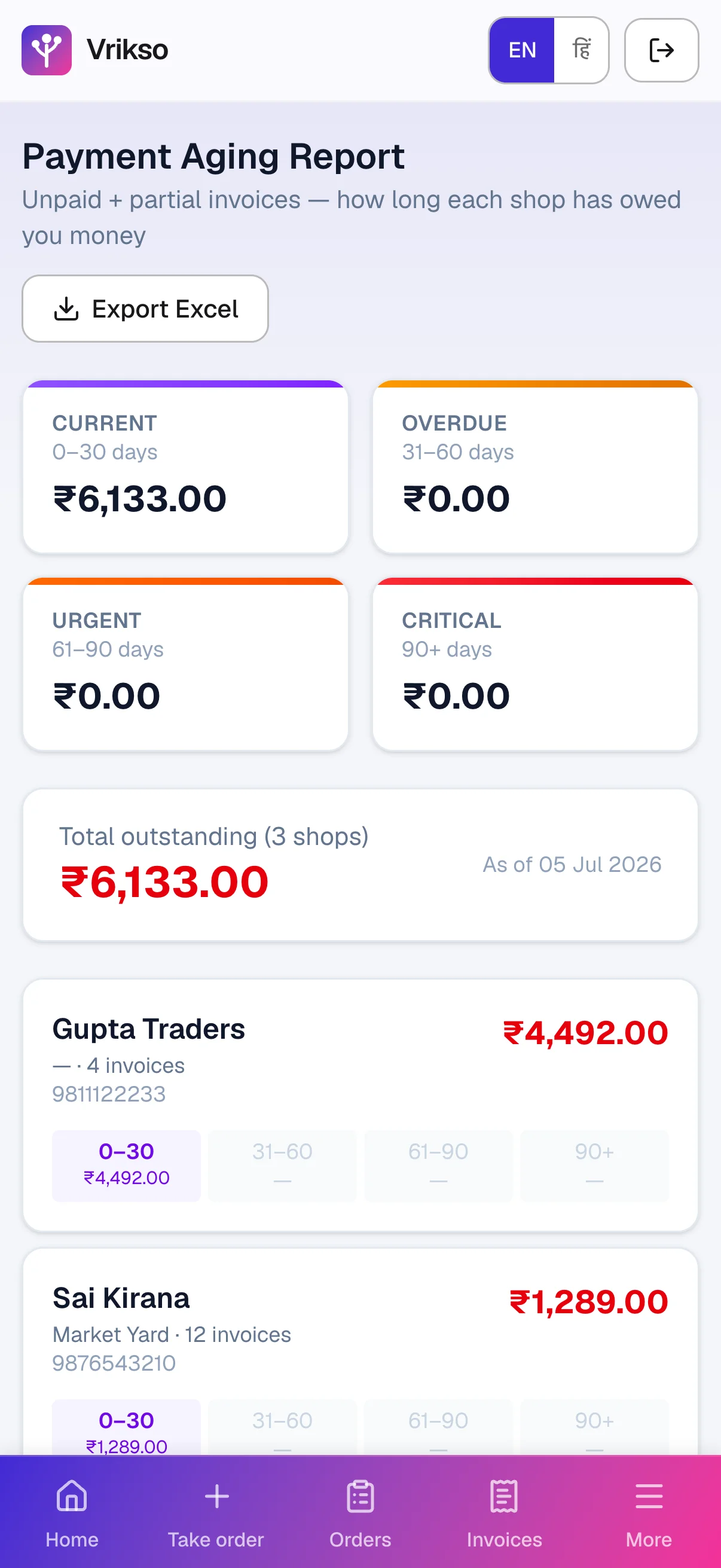
This is, honestly, the part where software earns its fee. Vrikso keeps a live ledger per customer, groups outstanding into aging buckets (0–30, 31–60, 61–90, 90+ days), and sends the invoice and balance on WhatsApp automatically — so Step 1 and Step 2 of the ladder happen without you typing a word, for every customer, every time. Plans start at ₹0, with paid tiers at ₹299 and ₹799/month — less than the interest lost on one stuck bill.
Frequently asked questions
How do I ask for pending payment without spoiling the relationship?
Send a written statement with the exact amount and ask for a date, not the money: 'Please check and tell me a convenient date.' Specific, factual, and face-saving — the ask feels like accounting, not accusation.
Can I recover udhaar if I have no written agreement?
Yes. Courts and councils accept invoices, delivery challans, khata entries, and WhatsApp chats as evidence of a running account. A customer's message acknowledging the balance is particularly strong — get the amount confirmed in writing whenever you can.
What is the time limit for recovering money legally in India?
Three years from the date the payment became due. A written acknowledgement of the debt (including on WhatsApp) restarts the three-year clock from that date.
What is MSME Samadhaan and who can use it?
A government portal (samadhaan.msme.gov.in) where Udyam-registered micro and small enterprises file complaints against buyers who haven't paid within 45 days. The buyer owes compound interest at 3× the RBI bank rate, and the state Facilitation Council targets disposal within 90 days. No lawyer or court fee is needed to file.
Are WhatsApp payment reminders legally valid?
Yes — WhatsApp messages are admissible as electronic evidence and create a dated trail of demands and acknowledgements. Keep the thread professional; it may become your annexure.
How much does a legal notice for payment recovery cost?
Typically ₹1,500–₹3,000 through a local advocate. It's often the highest-ROI step in the ladder: many disputes settle within the 15-day notice window.
What can I do about a bounced cheque in 2026?
Act fast: written demand within 30 days of the return memo, 15 days for the drawer to pay, then a criminal complaint under Section 138 NI Act within 30 more days. Miss the timelines and the criminal remedy lapses — though a civil claim survives.
How do I stop udhaar from piling up again?
Credit limits enforced by software (the next order blocks automatically), a weekly 15-minute review of the 90+ day aging bucket, and automatic WhatsApp statements. We covered the full prevention system here.
Udhaar is not a moral failure — yours or your customer's. It's a process failure, and processes can be fixed this week: send the statements today, put dates against every balance, freeze credit past 45 days, and let paper do the talking past 60. And if you'd rather a system ran the first two rungs for you across every customer automatically, try Vrikso free — your aging report will tell you within a day exactly where your money is sleeping.