Product sellers figured out GST years ago — every carton has an HSN code and a tax rate printed on it. Service people, on the other hand, often wing it. A designer, a consultant, a marketing agency, a photographer — the work is clear, but the invoice is frequently a Word document with a total and no idea whether GST even applies. That is fine until a client's accounts team asks for a proper tax invoice, or your turnover crosses a line you weren't watching.
The good news: GST for services is simpler than it looks. A handful of rules cover almost everything a freelancer or service business needs.
First: do you even need to register?
You must register for GST once your turnover crosses the threshold — for most service providers that is ₹20 lakh a year (₹10 lakh in some special-category states). Below that, registration is optional. But two situations force it regardless of turnover: supplying services to clients in other states, and selling through certain e-commerce platforms. If either applies to you, register even if you're small — it's cheaper than a notice later.
Services use SAC codes, not HSN
Goods have HSN codes; services have SAC codes (Services Accounting Codes). Every service you bill has one, and it belongs on the invoice. You don't need to memorise them — find the code for your kind of work once (design, consulting, software, catering) and reuse it. Most services attract 18% GST, though some categories differ, so confirm the rate for your specific SAC rather than assuming.
What a service tax invoice must show
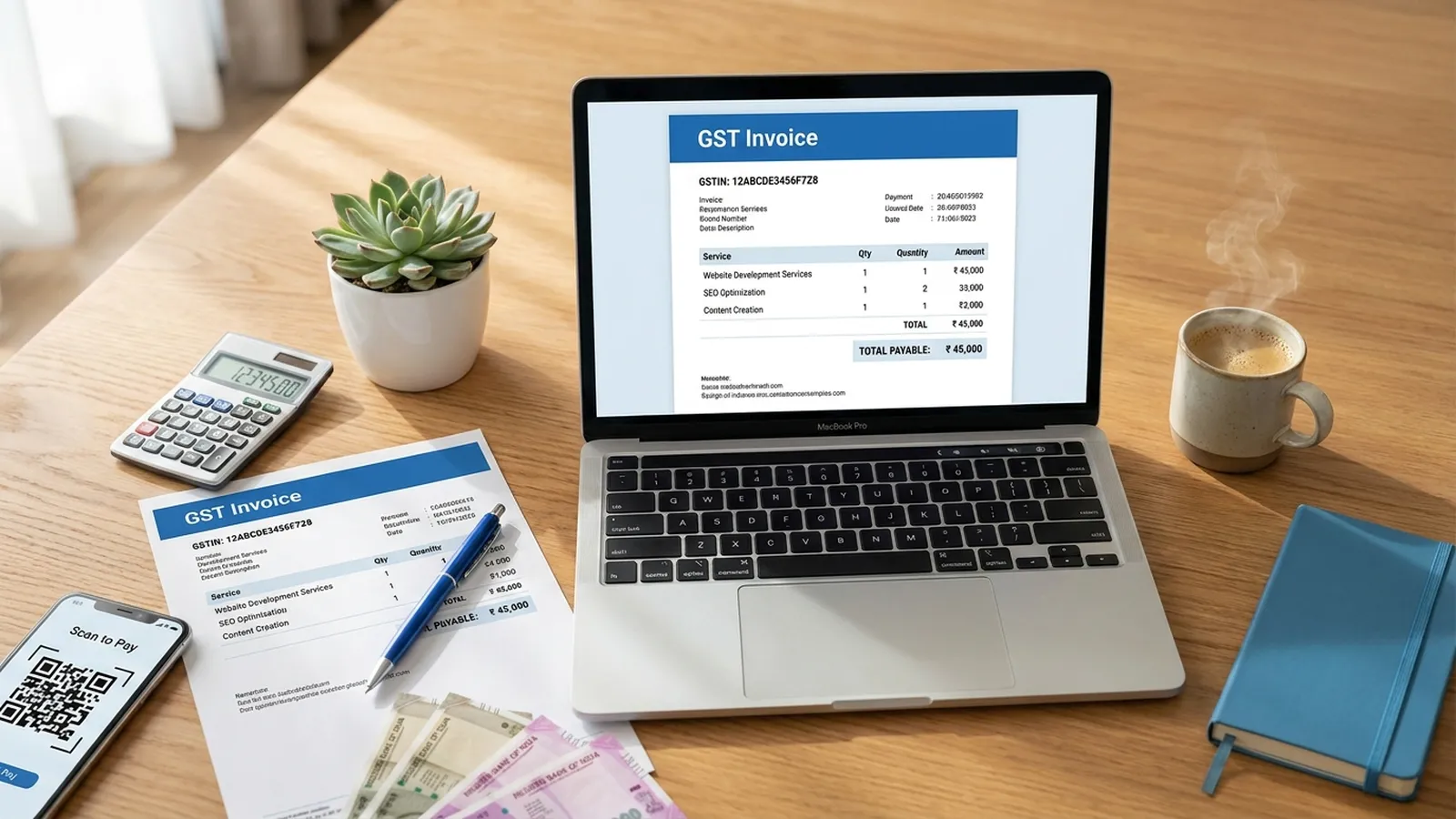
- Your name, address and GSTIN
- A unique, sequential invoice number and the date
- The client's name, address and GSTIN (for B2B)
- A clear description of the service and its SAC code
- Taxable value, the GST rate, and the tax amount split by head
- Place of supply — which decides whether it's CGST/SGST or IGST

CGST/SGST vs IGST — place of supply for services
The rule mirrors goods, but 'place of supply' for services can be less obvious. As a starting point: if your client is in the same state as you, the tax splits into CGST and SGST; if they're in another state, it's a single IGST at the full rate. For most straightforward service work, the client's location decides it. Get the place of supply right and the split takes care of itself.
Reverse charge, TDS and the client who deducts
Two things surprise first-time service billers. First, larger clients often deduct TDS on your fee — that's income tax withheld on your behalf, separate from GST, and you claim it back when you file your returns. Second, a few specific services fall under reverse charge, where the client pays the GST directly instead of you. Neither is a problem once you know it's coming; both cause panic when an unexpected deduction shows up on a payment.
Billing the same clients every month? Don't start from scratch
Retainers, AMCs and subscriptions mean raising nearly the same invoice over and over. Re-typing it each month is where numbers drift and invoices get forgotten. If that's your model, set the invoice to repeat automatically — we cover exactly how in our guide to recurring invoices.
You don't need to become a tax expert to bill correctly. You need clean, structured invoices with the right codes and splits, raised the moment the work is done and shared where the client will actually see them — usually WhatsApp or email. Do that consistently and GST stops being a season and becomes a non-event.