Ask a restaurant owner what commission they pay Zomato or Swiggy and most will quote the number from their contract — 18%, maybe 22%. Ask them what percentage of a ₹500 order actually reaches their bank account, and the room goes quiet. The two numbers are not close. Between the menu price and the settlement sit commission, payment charges, GST on the platform's fees, your share of discounts, ad spend and TDS — and none of it is presented in one place.
This is now a national argument. In March 2026 both platforms raised the customer platform fee to ₹17.58 per order — a 19% jump. The NRAI's antitrust case against the aggregators continues at the CCI. And from 15 August 2026, Bengaluru's hotel association has called a boycott of both platforms, with owners publicly showing the math: a ₹400 dish that nets roughly ₹220 after every deduction. Whatever side of that fight you're on, you should know your own number. Here is how to work it out.
Every charge on an aggregator order in 2026
Rates vary by city, plan and how much negotiating leverage you have — a new single-outlet restaurant pays more than a 40-outlet chain. But the stack itself is the same for everyone:
| Charge | Typical rate | Who bears it |
|---|---|---|
| Commission on order value | 18–28% for delivery (8–15% on some dine-in/older plans) | You |
| Payment & collection charges | ~2% (bundled into commission on some plans) | You |
| GST on the platform's charges | 18% of commission + fees — and at 5% GST without ITC, you cannot claim it back | You |
| Restaurant-funded discounts | Your agreed share of offers like '50% off up to ₹100' | You |
| Ads / visibility campaigns | Optional on paper; in a crowded category, effectively the cost of being seen | You |
| TDS under Section 194-O | 0.1% of gross sales (adjustable against income tax, but gone from this payout) | You, upfront |
| Platform fee | ₹17.58 per order since March 2026 | The customer — but it shrinks baskets and order counts |
| GST on food (5%) | Collected and remitted by the platform under Section 9(5) — you still report these sales in GSTR-3B | The customer |
The ₹500 order, line by line
Here is a realistic worked example for a single-outlet restaurant on a mid-tier plan — 22% commission, 2% collection charges, funding ₹40 of a discount, and running modest ads. Your contract will differ; the point is to see the shape of it:
| Line | Amount | What's left |
|---|---|---|
| Order value (menu price) | ₹500.00 | ₹500.00 |
| Commission @ 22% | − ₹110.00 | ₹390.00 |
| Payment & collection @ 2% | − ₹10.00 | ₹380.00 |
| GST @ 18% on platform charges (₹120) | − ₹21.60 | ₹358.40 |
| Your share of the discount | − ₹40.00 | ₹318.40 |
| Ads, averaged per delivered order | − ₹10.00 | ₹308.40 |
| TDS @ 0.1% | − ₹0.50 | ₹307.90 |
| Packaging (your own cost) | − ₹18.00 | ₹289.90 |
That ₹500 order settles at about ₹290 before you have paid for a single ingredient. Your contract says 22%; your effective commission — everything the channel costs you as a share of the order — is over 40%. That is the number that decides whether delivery is profitable for you, and it is the number almost nobody tracks.
Why the GST line stings more than it looks
Most restaurants charge 5% GST on food under the no-input-tax-credit scheme. That means the 18% GST you pay on commission, payment charges and ads is a pure cost — you cannot offset it against anything. On the ₹500 example, that's ₹21.60 leaving forever. And since September 2025, the delivery fee the platforms charge customers also carries 18% GST, which has pushed checkout totals up and nudged order volumes down. Meanwhile, even though the platform collects and remits the 5% on your food under Section 9(5), those sales still have to be reported in your GSTR-3B — a detail that trips up plenty of owners at filing time.
What the Bengaluru boycott is actually about
From 15 August 2026, the Bruhat Bangalore Hotels Association has asked member restaurants to stop taking orders from both platforms. Their stated math is the same stack you just saw: commissions up to 28%, plus 18% GST on those charges, plus TDS, plus ~2% payment charges. The CCI closed one complaint against the platforms in July, while the NRAI's broader case continues. Nobody knows how the boycott will play out — but the pressure has already produced one real change: Eternal (Zomato's parent) has said publicly that it is reviewing its commission structure. If you run a restaurant, the practical takeaway is not to pick a side. It is to know your effective commission precisely, so that whatever rates emerge next, you can decide in minutes whether a channel still works for you.
Five real ways to lower your effective commission
- Move your regulars to direct orders. Every repeat customer who orders on WhatsApp instead of the app takes their order from a ~40% effective cost to nearly zero. Put a QR and a phone number on every box.
- Get on ONDC. Network commissions run 3–5% against 18–28% on the aggregators. Volumes are smaller, but for the orders it brings, the margin difference is enormous.
- Cap and measure ad spend. Ads are the most elastic line in the stack. Set a monthly budget as a percentage of aggregator revenue, and check every month whether the incremental orders covered it.
- Engineer the delivery menu. Price delivery items to carry the channel's cost — bundles, combos and portions designed around what still tastes good after 25 minutes in a box. Your dine-in menu and your delivery menu do not have to match.
- Renegotiate with data. If you can show consistent volumes and a low cancellation rate, you have leverage at review time. Chains negotiate single digits off their rate; independents who show up with numbers do too.
Then check that you were actually paid it
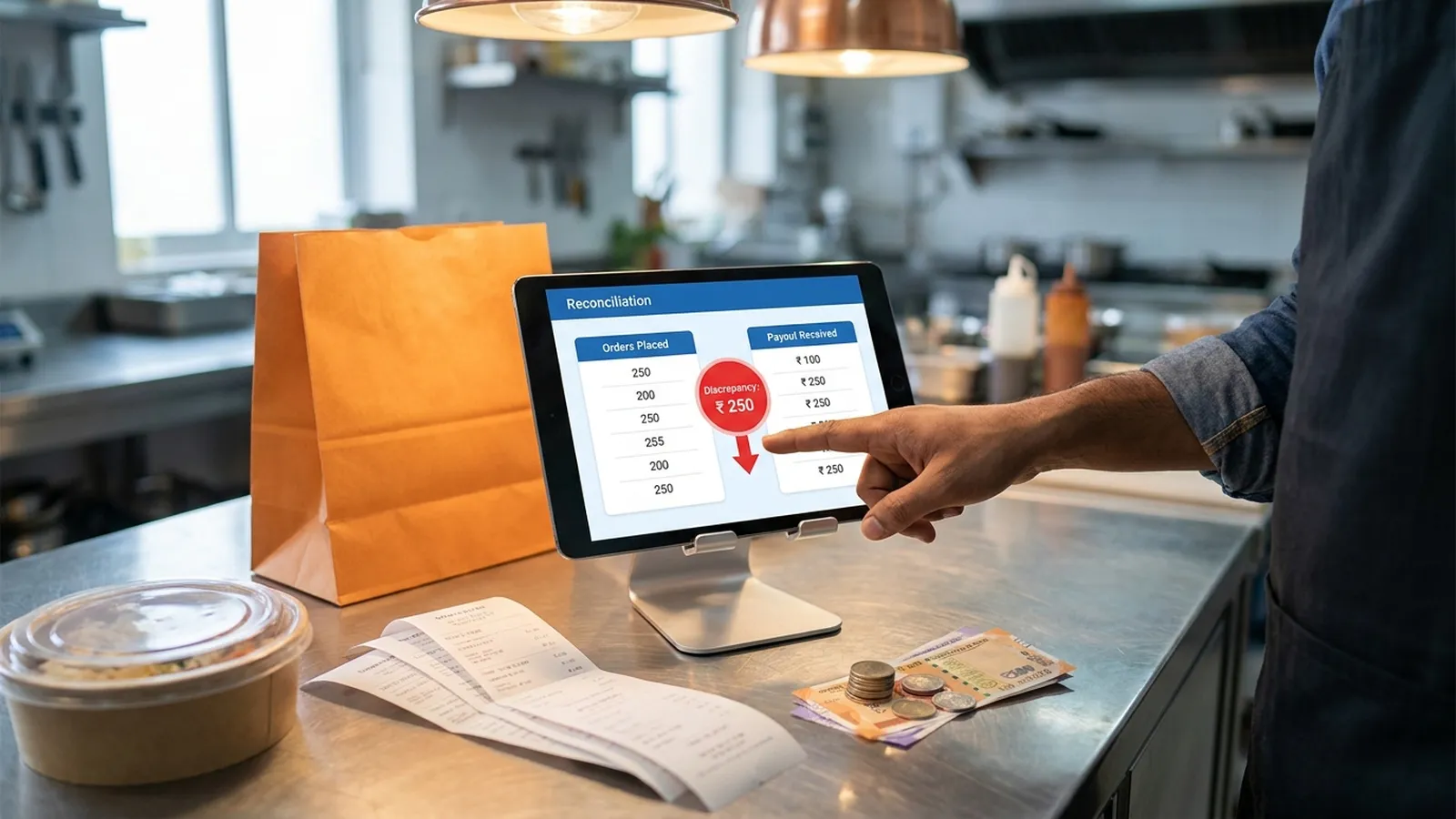
Everything above assumes the payout matches the math — and payouts routinely don't. Orders cooked but cancelled, discounts deducted twice, commission rates that creep after a plan change: that is a separate leak, and we wrote a full guide on it — Zomato & Swiggy reconciliation: where your online profit leaks. If your POS pulls aggregator orders into the same system as dine-in, checking a payout takes minutes instead of an evening; our restaurant POS buyer's guide covers what to look for.
Frequently asked questions
What percentage does Zomato take from restaurants in 2026?
Delivery commissions typically run 18–28% of order value depending on your city, plan and negotiating leverage, plus ~2% payment charges and 18% GST on all of those fees. New single-outlet restaurants usually start near the top of the range.
Is the ₹17.58 platform fee charged to the restaurant or the customer?
The customer pays it at checkout. It doesn't appear in your deductions, but it raises the customer's total, which shows up for you as smaller baskets and fewer orders — especially on low-value items.
Do restaurants pay GST on Zomato and Swiggy commission?
Yes — 18% GST applies on commission, payment charges and ad services. If you bill food at 5% under the no-ITC scheme (most restaurants do), you cannot claim any of it back, so it is a pure cost.
How can I get a lower commission rate?
Volume and reliability are the levers: consistent order counts, low cancellations and good ratings give you a case at plan-review time. Beyond negotiation, shifting regulars to direct WhatsApp orders and listing on ONDC (3–5% commission) lower your blended cost even if the aggregator rate stays put.
Can a small restaurant survive on Swiggy and Zomato alone?
Only with the math done honestly. If your effective commission is ~40% of order value, your food cost, packaging and rent have to fit in the remaining ~60%. It works for high-margin menus (beverages, desserts, some cuisines) and fails silently for others — which is why knowing your per-order number matters more than any general answer.
The platforms are not going away, and for most restaurants they shouldn't — reach is real. But 2026 is the year the industry stopped taking the payout on faith. Work out your effective commission this week: pull one payout report, run it through the table above, and put the final number next to your food cost. Whatever you decide about boycotts and channels after that, you'll be deciding with your own math.