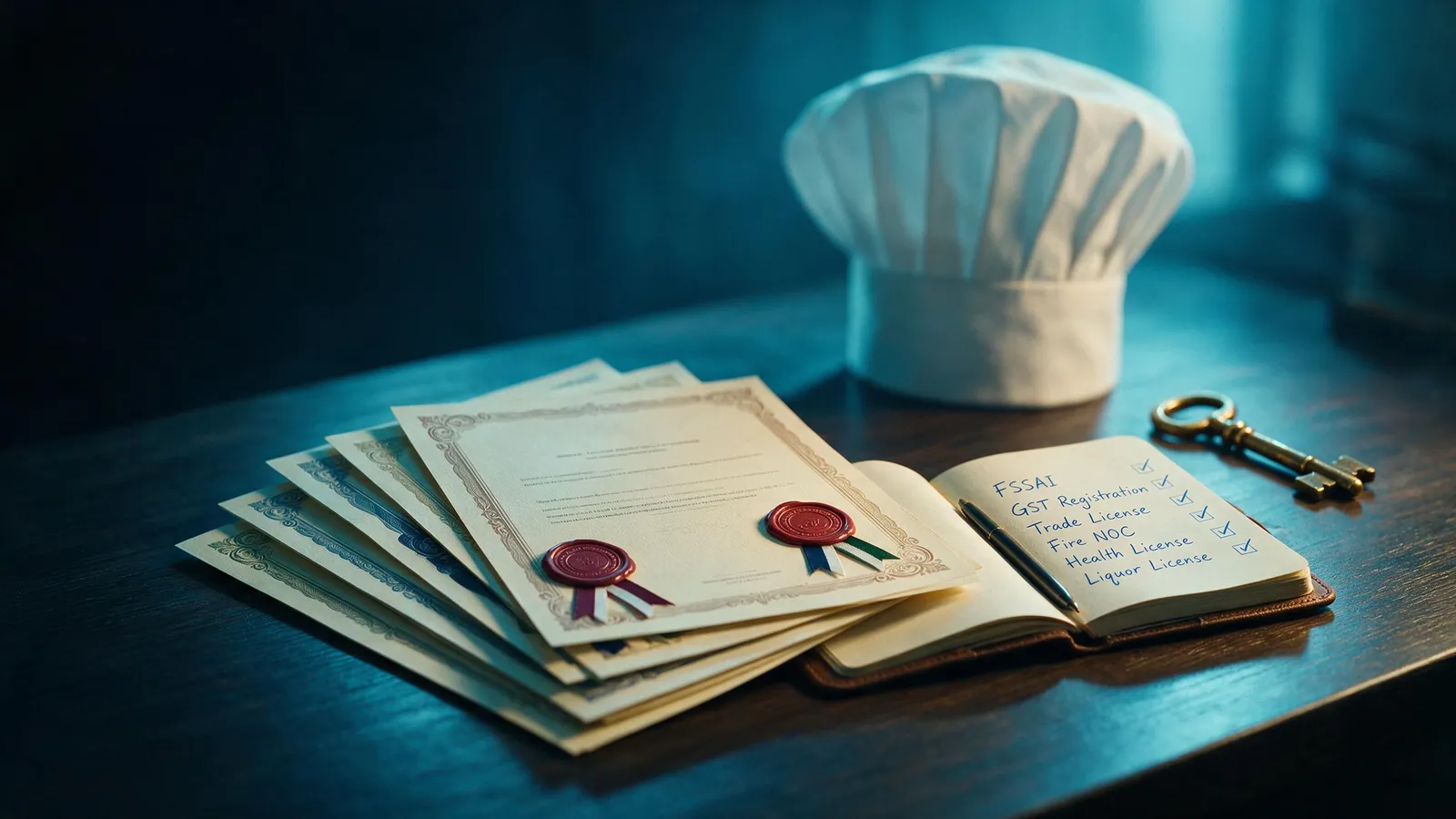
Ask five people how many licenses a restaurant in India needs and you will get five answers, all of them 'FSSAI plus a few others'. The honest answer: a typical dine-in restaurant needs 6 to 9 separate registrations before it can legally serve its first plate, and a bar or a large-format place can need 12. Miss one and the consequences range from a municipal fine to a sealed shutter on a Friday night.
2026 is also the year the rulebook genuinely changed. On 10 March 2026, FSSAI notified amendments that took effect on 1 April 2026 — licenses are now perpetually valid (no more renewals), and the turnover slabs that decide which license you need moved dramatically. Most guides on the internet were written before this and are now wrong. This one is current. Here is every license, what it actually costs, who issues it, and the order to apply in.
The full list at a glance
| License | Issued by | Typical cost | Time to get |
|---|---|---|---|
| FSSAI registration / license | FSSAI via FoSCoS portal | ₹100–₹7,500 per year | 7–60 days |
| GST registration | GST portal | Free | 3–7 working days |
| Health / trade license | Municipal corporation | ₹5,000–₹25,000 per year | 15–30 days |
| Eating house license | City police (licensing unit) | ₹300–₹3,000 | 30–60 days |
| Shops & establishment registration | State labour department | ₹200–₹5,000 (state-wise) | 1–15 days |
| Fire NOC | State fire department | Nominal fee + compliance cost | 15–30 days |
| Liquor license (if serving alcohol) | State excise department | ₹5.5 lakh–₹36 lakh+ per year | 30–90 days |
| Music license (PPL / IPRS) | PPL India, IPRS | ₹3,750–₹50,000+ per year | 1–7 days |
| Signage license | Municipal corporation | Varies by size/city | 7–15 days |
1. FSSAI registration or license — the one everyone knows
Every food business in India — restaurant, café, dhaba, cloud kitchen, home kitchen — must hold either an FSSAI Registration or an FSSAI License before operating. It is the only license on this list that is unambiguously mandatory for everyone, and the 14-digit number must be printed on your bills and displayed at the premises.
Which one you need depends on annual turnover, and the slabs changed on 1 April 2026:
| Type | Turnover (from 1 Apr 2026) | Government fee |
|---|---|---|
| Basic Registration | Up to ₹1.5 crore | ₹100 per year |
| State License | ₹1.5 crore – ₹50 crore | ₹2,000–₹5,000 per year |
| Central License | Above ₹50 crore | ₹7,500 per year |
Apply on the FoSCoS portal (foscos.fssai.gov.in). You'll need identity and address proof, proof of premises (rent agreement or ownership papers), a list of food categories, and — under the tightened 2026 process — a water test report from a NABL-accredited lab and a Food Safety Management System (FSMS) plan for license applications. Registration typically comes through in about a week; State and Central licenses take 30–60 days because an inspection may be involved.
2. GST registration
GST registration is mandatory once turnover crosses ₹20 lakh (₹10 lakh in special-category states) — a threshold most restaurants cross quickly. Most restaurants bill food at 5% GST without input tax credit; the composition scheme is also available at 5% up to ₹1.5 crore turnover. If you plan to sell on Zomato or Swiggy, note that the platforms collect and remit the 5% on food under Section 9(5), but you still report those sales in your returns — we covered the mechanics in our guide to what you actually keep on a ₹500 aggregator order.
Registration itself is free on the GST portal and takes 3–7 working days with Aadhaar authentication. Once registered, your real work is monthly discipline — invoices, GSTR-1 and GSTR-3B. Our GSTR-1 guide walks through it.
3. Health / trade license from the municipal corporation
Issued by your city's municipal body (MCD in Delhi, BBMP in Bengaluru, BMC in Mumbai), the health trade license certifies that your premises meet sanitation and public-health norms. Fees run roughly ₹5,000–₹25,000 per year depending on the city and the size of the establishment — NDMC, for instance, charges restaurants with up to 50 seats ₹5,000 a year. Expect an inspection and a 15–30 day timeline. Many owners discover this one only when the corporation's inspector does.
4. Eating house license from the police
Anywhere food or drink is supplied to the public needs an eating house license from the city police licensing unit — in Delhi, under the Delhi Police Act. The official fee is small (around ₹300 in Delhi; ₹500–₹3,000 with variations elsewhere) but the process is document-heavy and takes 30–60 days, because it rides on your other approvals: expect to show your FSSAI number, trade license and fire clearance. A few states have moved to simplify or scrap police licensing for restaurants — check the current position in your city before assuming either way.
5. Shops & establishment registration
Required in every state within 30 days of starting operations, this registers your restaurant as an employer and governs working hours, weekly offs and employee records. Fees are modest (a few hundred to a few thousand rupees, scaled to headcount) and most states now issue it online in days. It is also the document banks most often ask for when you open a current account.
6. Fire NOC
A No Objection Certificate from the state fire department is typically compulsory for restaurants above a seating or floor-area threshold (commonly 50 seats, or premises in high-rise buildings) — but after several high-profile restaurant fires, inspectors in metro cities increasingly expect basic compliance from everyone: extinguishers, clear exits, and a kitchen suppression arrangement for large setups. The certificate fee is nominal; the real cost is the equipment. Budget ₹30,000–₹1 lakh for a small dine-in's fire-safety fit-out and 15–30 days for inspection and issue.
7. Liquor license — the expensive one
If you serve alcohol, everything above is a rounding error. Excise is a state subject, so costs vary wildly:
| State / city | License type | 2026 cost |
|---|---|---|
| Delhi | L-17 (restaurant/bar) | ~₹7.8 lakh/yr up to 50 seats; ~₹36 lakh above 200 seats |
| Mumbai (Maharashtra) | Permit room | ~₹5.5–6 lakh per year |
| Bengaluru (Karnataka) | CL-9 (bar), via e-auction | ₹70–90 lakh base for 5 years; winning bids cross ₹1.5 crore |
| Uttar Pradesh | Bar license | ~₹8–15 lakh per year |
Timelines run 30–90 days and most states have moved applications to online excise portals. If alcohol is central to your concept, get the excise conversation started before you sign a lease — a premises that can't get a liquor license (near a school, temple or highway, depending on state rules) kills the business model on day one.
8. Music license — the one everyone forgets
Playing recorded music in a commercial space requires a license under the Copyright Act, 1957. Two bodies collect: PPL India for recorded music (tariffs start around ₹3,750 per year for premises up to 500 sq ft and scale with area) and IPRS for the underlying compositions and live performances (roughly ₹10,000 per year in metros, ₹5,000 elsewhere). Many restaurants need both. Enforcement is real — rights bodies send legal notices to restaurants and cafés playing unlicensed music, and settlements cost far more than the tariff.
9. The smaller ones: signage, lift, environment, weights & measures
- Signage license — your glow sign or board outside is advertising under municipal law; fees scale with size and location.
- Lift clearance — if your premises has an elevator, the state electrical inspectorate must certify it.
- Environmental consent — large kitchens (and anything with significant effluent or a big genset) may need Consent to Operate from the state pollution control board.
- Legal metrology registration — only if you also sell packaged goods with a declared weight (a bakery counter, packaged sweets) — your weighing instruments and labels come under Weights & Measures rules.
What a real 40-seat restaurant pays in year one
| Item | Without bar | With bar (Delhi) |
|---|---|---|
| FSSAI (Basic Registration) | ₹100 | ₹100 |
| GST registration | Free | Free |
| Health/trade license | ₹5,000–₹15,000 | ₹5,000–₹15,000 |
| Eating house license | ₹300–₹3,000 | ₹300–₹3,000 |
| Shops & establishment | ₹1,000–₹5,000 | ₹1,000–₹5,000 |
| Fire NOC + equipment | ₹30,000–₹1,00,000 | ₹30,000–₹1,00,000 |
| Music license (PPL + IPRS) | ₹10,000–₹25,000 | ₹10,000–₹25,000 |
| Liquor license (L-17) | — | ~₹7,84,000 |
| Total (approx.) | ₹50,000–₹1.5 lakh | ₹8.6–9.4 lakh |
The right order to apply in (60–90 day plan)
- Before signing the lease: check the premises can get a fire NOC and (if relevant) a liquor license. Verify the building's use is commercial.
- Week 1–2: apply for FSSAI on FoSCoS, GST registration, and shops & establishment. These don't depend on anything else.
- Week 2–4: apply for the municipal health/trade license and signage license; start the fire-safety fit-out.
- Week 4–8: with FSSAI, trade license and fire papers in hand, apply for the eating house license. Apply for the liquor license in parallel if you're serving.
- Before opening day: take the PPL/IPRS music licenses (they issue quickly), print your FSSAI number on the bill format, and display the licenses at the premises.
If you're building a delivery-only operation instead, the stack is shorter — no eating house license, no music license, usually no liquor — and we've covered that separately in our cloud kitchen guide. And once the paperwork is done, the next decision is the billing system that prints that FSSAI number on every KOT and bill — here's how to choose a restaurant POS.
What skipping a license actually costs
- Operating without FSSAI registration is a criminal offence — penalties run up to ₹5 lakh and can include imprisonment, and the premises can be shut on the spot.
- No trade license: municipal fines that compound, and sealing in repeat cases.
- No eating house license: the police can close the establishment — this is the one that produces the Friday-night shutdown stories.
- Serving liquor without excise permission: seizure, prosecution and blacklisting from future licenses.
- Unlicensed music: copyright infringement notices with damages claims that dwarf the annual tariff.
Frequently asked questions
How many licenses are required to open a restaurant in India?
A typical dine-in restaurant needs 6–9: FSSAI, GST registration, municipal health/trade license, eating house license, shops & establishment registration, fire NOC and music licenses. Add a liquor license if you serve alcohol, and signage/lift/environmental clearances where applicable — up to 12 in all.
What is the FSSAI license fee for a restaurant in 2026?
₹100 per year for Basic Registration (turnover up to ₹1.5 crore — most independent restaurants after the April 2026 amendment), ₹2,000–₹5,000 for a State License (₹1.5–50 crore) and ₹7,500 for a Central License (above ₹50 crore).
Do FSSAI licenses still need renewal in 2026?
No. From 1 April 2026, FSSAI registrations and licenses have perpetual validity — they no longer expire. You must still pay the annual fee every year to keep the approval alive.
How much does it cost to get all restaurant licenses in India?
For a restaurant without a bar, budget roughly ₹50,000–₹1.5 lakh in year one — most of it fire-safety equipment rather than government fees. A liquor license changes everything: ₹5.5–8 lakh per year in Mumbai or Delhi, and effectively ₹30 lakh+ per year equivalent in Bengaluru's e-auction system.
Can I open a restaurant while licenses are pending?
Legally, no — FSSAI in particular must be granted before you begin operations, and the eating house license is required to open to the public. In practice many owners soft-launch on a granted FSSAI registration while slower approvals are in process, but you carry the risk: police and municipal inspectors can and do close premises operating without their respective licenses.
Does a cloud kitchen need the same licenses as a restaurant?
It needs fewer: FSSAI, GST, trade license and shops & establishment, plus a fire NOC for the kitchen. It generally does not need an eating house license (no public seating), a music license or a liquor license. See our full cloud kitchen guide for the delivery-only stack.
Is GST registration mandatory for a small restaurant?
It becomes mandatory once annual turnover crosses ₹20 lakh (₹10 lakh in special-category states). Below that it's optional — but if you plan to list on Zomato or Swiggy or bill corporate clients, registering early usually saves friction.
Licensing is the least glamorous part of opening a restaurant, and the part most likely to shut one. The good news in 2026: the biggest license just became cheaper and permanent, and almost everything can be applied for online. Do it in the order above, keep the annual fees on a calendar, and the paperwork becomes a one-time project instead of a recurring emergency. When you're ready for the systems that come after the licenses — KOTs, GST bills with your FSSAI number, aggregator orders in one place — that's what Vrikso for restaurants is built for, starting free.